At Solar Ladder, we’ve engineered a generation engine designed to handle the unique complexities of the Indian landscape—from the dense smog of Delhi to the massive utility scales of the North East. To prove its reliability, we conducted an extensive benchmarking exercise against PVSyst, the global industry gold standard.
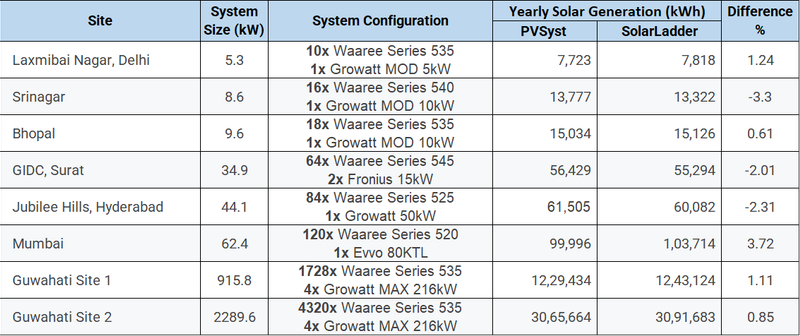
Our validation covered 8 diverse sites across India, testing everything from 5.3 kW residential rooftops to 2.2 MW utility-scale ground mounts. We meticulously modeled variables like GHI/DNI irradiance, 3D shading, and electrical ohmic losses to ensure bankable results.
The Results: Precision at Scale
Across all 8 test cases, Solar Ladder demonstrated exceptional alignment with PVSyst standards:
- Average Generation Difference: 1.89%
- Maximum Observed Variance: Within ±3.7%
- Scalability: Validated from 5 kW to 2.2 MW systems
- No of Sites Compared: 8 Sites
Tested Across All Geographies & Conditions
To ensure our engine works for every installer in India, we tested the engine across the length and breadth of India.
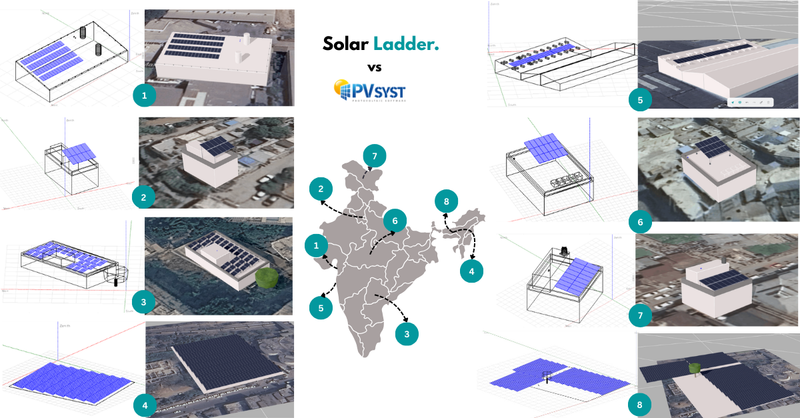
- Residential Rooftop (RCC): Validated in Delhi (5.3 kW), Bhopal (9.6 kW), and Srinagar (8.6 kW).
- Industrial Metal Shed: Tested in Surat (34.9 kW) and Mumbai (62.4 kW).
- Commercial Rooftop: Analyzed in Hyderabad (44.1 kW) with complex dense-row layouts.
- Utility-Scale Ground Mount: Rigorously tested in Guwahati at both 915 kW and 2.2 MW scales.
Engineering Focus: Shading Scenarios Tested
Our engine was put through various "stress tests" to verify how it handles real-world obstructions:
- Multi-Inverter & Auto-Stringing: Validated the accuracy of complex electrical mapping, testing the engine’s ability to synchronize multiple high-capacity inverters and handle automated stringing logic.
- Hard Shading: Modeled solid obstructions like water tanks, lift rooms, and parapet walls.
- Complex Geometry: Handled curved shadows from cylindrical industrial towers.
- Soft/Dynamic Shading: Calculated moving shadows from nearby trees affecting specific strings.
- Self-Shading: Validated inter-row shading in high-density commercial and utility-scale arrays.
- Horizon Shading: Mapped shadows cast by adjoining taller buildings in industrial zones.
Conclusion
The data is clear: Solar Ladder provides PVSyst-level confidence with the speed of a modern web-app. By maintaining a consistent, 1.89% average difference, we ensure that your proposals are not just optimistic promises, but bankable realities.